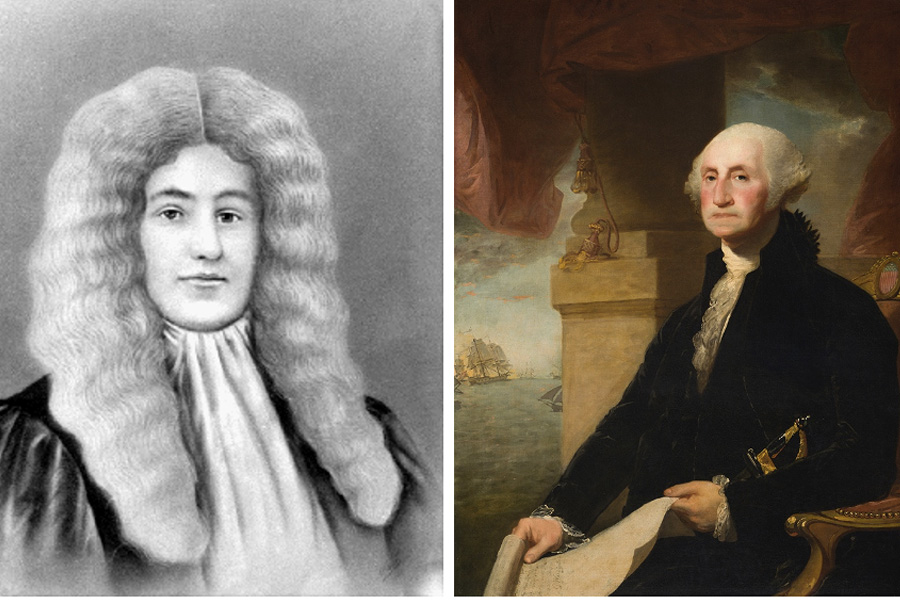
A man placed at the center of colonial Virginia
I think of Augustine Warner Jr. as one of those figures who stands like a sturdy gatepost at the edge of early Virginia history. He was not merely a planter with land and titles. He was a political operator, a militia colonel, a Speaker of the House of Burgesses, and a member of the Governor’s Council. He lived from 1642 to 1681, a short life by our standards, yet one packed with inheritance, duty, conflict, and family legacy.
He was born on 3 June 1642, educated in London at Merchant Taylors’ School in 1658, and later returned to Virginia to step into the world his father had built. That world was Warner Hall, the family estate in Gloucester County, a place that was part manor, part fortress, and part symbol. It was the kind of property that cast a long shadow over every generation connected to it.
What makes Augustine Warner Jr. so compelling is not only his own career, but the way his life became a hinge between families. Through him, one branch moved toward the Washingtons, another toward the Lewises, another toward the Smiths, and still another into broader transatlantic gentry networks. He was a root system, invisible in some ways, yet feeding several mighty trees.
The Warner household and the inheritance of rank
Augustine Warner Jr. was from a Virginia family. He was born to colonial leader Augustine Warner Sr., who founded Warner Hall. Mary Towneley (or Townley) was his mother. That family background was crucial. In the 17th century, rank was gained. It was inherited, defended, and displayed.
The only son continued the Warner estate. That alone strained his life. The estate was more than land. It combined memory, work, debt, and expectation. Augustine Jr. inherited Warner Hall in 1674, more than a home and land. His identity was publicized.
His siblings are rarely seen, yet they matter in the family. Other daughters or collateral lines exist in various family traditions after Sarah Warner married Lawrence Townley. Like ink on wet paper, the Warner name expanded through marriage, creating connected families that shaped Virginia culture.
Marriage, children, and a lineage that stretched across centuries
Augustine Warner Jr. married Mildred Reade around 1665. This marriage joined two respected colonial families and created one of the most important family lines in Virginia history. Mildred was the daughter of George Reade and Elizabeth Martiau. In some historical retellings, her name appears with variation, but the family role is clear. She was the matriarch who carried the Warner bloodline into future generations.
They had six children:
| Child | Notes |
|---|---|
| Elizabeth Warner | Married John Lewis, Jr. |
| Mary Warner | Married John Smith of Purton |
| Mildred Warner | Married Lawrence Washington and later George Gale |
| Augustine Warner III | Died young |
| George Warner | Died without issue |
| Robert Warner | Died without issue |
That family table looks neat on the page, but the lives behind it were anything but simple. In colonial families, children were not only children. They were heirs, alliances, and living bridges between estates.
Elizabeth Warner is one of the most important daughters because her descendants tied Warner Hall to the Lewis family, and from there to figures such as Fielding Lewis and Meriwether Lewis. Mary Warner carried the line into another branch that later reached far beyond Virginia. Mildred Warner is the most famous of the daughters because she married Lawrence Washington and became the mother of Augustine Washington, who was the father of George Washington.
That means Augustine Warner Jr. was George Washington’s great-grandfather. In the architecture of American memory, that relationship is like a hidden beam supporting a famous façade. The founder of a nation rises in one century, but the framing of that story begins long before him.
Public office, rebellion, and the weight of loyalty
Augustine Warner Jr. did not live quietly on inherited wealth. He entered the House of Burgesses around 1672 for Gloucester County. By March 1676, he had become Speaker. He held that position again in February 1677. He also served on the Governor’s Council from 1677 until his death in 1681, and he acted as colonel of the Gloucester County militia.
His career was shaped by Bacon’s Rebellion, one of the sharpest crises in colonial Virginia. Warner remained loyal to Governor Berkeley while Nathaniel Bacon’s forces tore through the colony. Warner Hall was seized and damaged. The rebellion did not just shake politics. It struck homes, storehouses, and reputations. I picture that moment as a candle flame pressed under a storm glass. The light was still there, but everything around it trembled.
After the rebellion, Warner pursued claims for losses, including goods and merchandise valued at £845, a considerable sum in the 17th century. That number is important because it shows the scale of the damage and the scale of his standing. Men at his level did not merely lose property. They lost leverage.
Yet he remained part of Virginia’s governing elite. That persistence says a great deal. He was not a fleeting figure. He was a stabilizing one, even in a turbulent era.
Warner Hall as a family emblem
Warner Hall was more than a home. Stage, storehouse, emblem, and promise. After Augustine Warner Jr. inherited it in 1674, it dominated his public and private life. Despite rebellion damage and legal challenges, it remained the family focus.
The estate represented a family archive in the landscape. Every room, farm, and fence line remembered marriage, death, labor, and authority. Modern institutions use logos and trademarks; colonial elites utilized land. The estate identified people before they spoke.
The children’s marriages made the home more influential. Warner Hall was no longer family-only. It started a bigger American ancestry web.
A family line that reached famous names
The descendants of Augustine Warner Jr. are one reason historians and genealogists still return to him. His daughter Mildred’s marriage to Lawrence Washington linked him to the Washington line. Through that line came George Washington. His daughter Elizabeth tied the family to the Lewis line. His daughter Mary created another branch that reached into later notable families. The Warner bloodline became a river with several branches, each carrying its own current.
Here is the simplest way to see the larger pattern:
| Family connection | Historical significance |
|---|---|
| Augustine Warner Sr. | Founder of the Warner family estate and political patriarch |
| Mary Towneley | Mother of Augustine Warner Jr. |
| Mildred Reade | Wife and connector to the Reade and Martiau families |
| Elizabeth Warner | Linked Warner Hall to the Lewis family |
| Mary Warner | Extended the family into another colonial line |
| Mildred Warner | Linked the family to the Washington line |
| George Washington | Great-grandson of Augustine Warner Jr. |
That structure matters because it shows how family life in colonial Virginia worked. Marriage was not just personal. It was political architecture. Each union set another beam in place.
Dates that mark a brief but heavy life
I often find that dates reveal a biography better than praise does. Augustine Warner Jr. had a life marked by a few clear points:
- 1642: born
- 1658: studied at Merchant Taylors’ School in London
- about 1665: married Mildred Reade
- about 1672: entered the House of Burgesses
- 1674: inherited Warner Hall
- March 1676: served as Speaker
- 1677: joined the Governor’s Council
- 19 June 1681: died and was buried at Warner Hall
That is only a handful of dates, but each one lands with weight. His life moved quickly. It had the compact force of a hammer strike.
FAQ
Who was Augustine Warner Jr.?
Augustine Warner Jr. was a 17th-century Virginia planter, politician, militia colonel, and Speaker of the House of Burgesses. He was also one of the central ancestors linking several major American colonial families.
Why is Augustine Warner Jr. important?
He matters because of both his public role and his family line. He served in colonial government during a tense period, and his descendants connected him to the Washington, Lewis, and Smith families. He is a key figure in the ancestry of George Washington.
Who were his wife and children?
He married Mildred Reade around 1665. Their children were Elizabeth, Mary, Mildred, Augustine III, George, and Robert. The three daughters became especially significant because their marriages carried the family forward into other prominent lines.
What was Warner Hall?
Warner Hall was the Warner family estate in Gloucester County, Virginia. It was inherited by Augustine Warner Jr. in 1674 and served as the family’s political and social center. It was both a home and a symbol of status.
What happened during Bacon’s Rebellion?
During Bacon’s Rebellion, Warner Hall was seized and damaged by Bacon’s forces, while Augustine Warner Jr. remained loyal to Governor Berkeley. Afterward, he pursued claims for property losses and remained part of the colony’s ruling elite.
How is Augustine Warner Jr. connected to George Washington?
He was George Washington’s great-grandfather through his daughter Mildred Warner, who married Lawrence Washington and became the mother of Augustine Washington, George Washington’s father.