A quiet descendant of a loud legacy
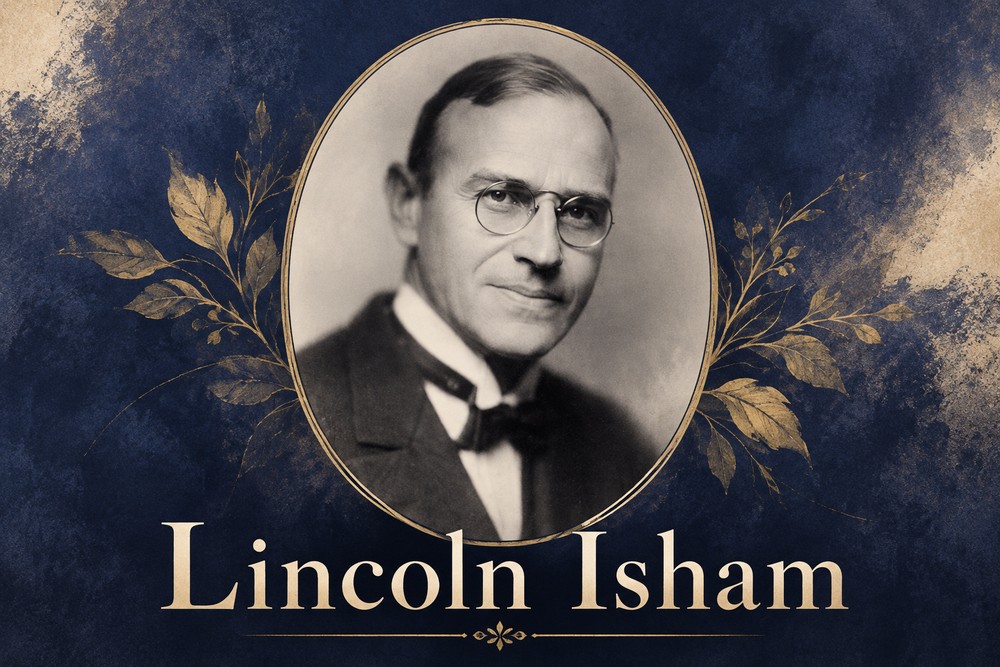
I have always been struck by the paradox of Lincoln Isham. His name is a drumroll. His life is a whisper. Born Abraham Lincoln Isham on June 8, 1892, in New York City, he carried the weight of America’s most famous surname while choosing a path that shunned noise and spotlight. He died on September 1, 1971, in Dorset, Vermont, and is buried in Dellwood Cemetery, tucked into the hills where he chose to live simply. He seems like a figure painted in muted tones, positioned at the edge of a grand mural, content to watch rather than pose.
Family roots and relationships
The roots of Lincoln Isham’s life reach deep into intertwined American stories. He was the only child of Mary Todd Mamie Lincoln and Charles Bradford Isham. Mamie was the eldest daughter of Robert Todd Lincoln and Mary Harlan Lincoln, and thus Lincoln was the great-grandson of President Abraham Lincoln and Mary Todd Lincoln. Through his paternal line he also belonged to a prominent New York family. His grandfather William Bradley Isham made his name in commerce and banking, and the Isham family became recognizable fixtures in New York society.
Lincoln’s grandparents on the Lincoln side were formidable figures. Robert Todd Lincoln served as Secretary of War and was a leading corporate lawyer. Mary Harlan Lincoln managed family affairs with steady resolve. Through them, the family maintained Hildene in Manchester, Vermont, a place of summers, photographs, and careful memory. On Mamie’s side were the Harlands and the powerful influence of Senator James Harlan, which anchored the family in public service and civic obligations. On his father’s side, Lincoln inherited the Isham family’s taste for culture and books, as Charles Bradford Isham served as librarian to a major historical society and moved in literary circles.
He had no siblings. He did, however, have nearby Lincoln cousins through Mamie’s siblings, including Jessie Harlan Lincoln and the short-lived Abraham Lincoln II, known as Jack. That small kinship web amplified the sense that his was a dwindling branch of a towering tree. He would live out his years as one of the last direct descendants with the Lincoln name near his own.
Marriage and private life
In 1919, the same year his father died, Lincoln Isham married Leahalma Correa. Notices of their marriage describe her with cosmopolitan roots, Spanish and English in background. By most accounts they had no children together. Several genealogical notes suggest that Lincoln helped raise a stepdaughter often listed as Frances Mantley. The documentation around that relationship is thinner than one would like. It sits on the borderland between family memory and official record, which I acknowledge plainly.
The marriage placed Lincoln in a private orbit. He split his life between a refined New York identity and a quieter existence in Vermont. The Vermont years paint the clearest portrait of his preferences. He cultivated a life that was domestic and understated, with small rituals and personal interests rather than public roles.
Work, craft, and pursuits
Lincoln Isham’s career never defined the headlines. He is often described as an amateur musician and an art collector, a man who curated an inner world with sound and canvas. That phrasing suits him. He did not run a firm or make a splash as a politician. He had the means, and he seems to have preferred taste to trade, composition to competition.
His New York upbringing exposed him to the arts, and the Isham family’s cultural connections gave him both permission and access. In later years, his Dorset life added a pastoral rhythm. Some accounts describe him owning farmland, perhaps around a couple dozen acres, which fits the Vermont cadence of work that is measured more by weather and season than by clock or stock ticker.
Estates, philanthropy, and heirlooms
What a person does with a lifetime often becomes clearest at the end. When Lincoln died in 1971, notices described charitable bequests to national organizations, including large and trusted nonprofits such as the Red Cross and the Salvation Army. There are also recurring references to a trust established for a stepdaughter, often quoted at 440,000 dollars, though that specific number is more commonly found in family compilations than in formal probate summaries. A careful reader will hear me reserving judgment on the exact amount, while acknowledging the persistence of the figure.
He is also associated with the placement of family heirlooms into public collections. Items tied to Mary Todd Lincoln and the Lincoln household are said to have passed into institutions. That choice, if fully documented across all items, would be in keeping with a family sensibility that blends duty, remembrance, and the desire to keep artifacts in the light rather than locked in private rooms.
Places and properties
He grew up in a New York shaped by townhouses, churches, and clubrooms. His mother maintained a well-known Manhattan address for decades, a stone facade that still draws curiosity. In recent years, that property has been written about again, with modern real estate eyes marveling at its price tag and history.
Vermont, and Dorset especially, gave Lincoln something softer. Green hills. Stone walls. Quiet roads. It feels right that his life closed in a place where the landscape speaks in hushes, not shouts.
Anecdotes and unverified lore
Families are stitched with story. One of the most oft-repeated tales places a teenage Lincoln Isham behind the wheel of his grandfather Robert Todd Lincoln’s early automobile. The car, a 1905 Thomas, met a ditch. Grandfather was displeased. It is the sort of anecdote families love, a small parable about youth, technology, and patience.
Other claims deserve a gentle caution. You may encounter statements that he left Harvard due to frail health or that he worked secretly for the United States government during World War II. These stories surface repeatedly, but firm documentation is not readily presented alongside them. I treat them as unverified. They may be true in part, or they may be family myths that hardened into lore over time.
Timeline highlights
- 1892: Born in New York City, named Abraham Lincoln Isham, known as Lincoln or Linc.
- 1890s to early 1900s: Childhood shaped by New York culture and visits to Vermont family grounds.
- 1907 or thereabout: Family story of the auto mishap with Robert Todd Lincoln’s car.
- 1919: Death of his father, Charles Bradford Isham. Marriage to Leahalma Correa later that year.
- 1920s to 1930s: Emergence as a private collector and amateur musician, flexible between New York and Vermont.
- 1938: Death of his mother, Mamie. Family objects and portraits continue their journey through heirs and eventually into public view.
- 1971: Death in Dorset, Vermont. Charitable bequests and a reported trust mark the punctuation of his estate.
The texture of a life in the shadow of a monument
I imagine Lincoln Isham as a man who learned to let history breathe beside him without trying to wrestle it. He did not make speeches. He did not ride the name like a parade horse. He tended it, like a gardener working the edges of a grand old lawn, trimming where needed, allowing certain blooms to show.
Names can be burdens. They can also be bridges. Lincoln lived with a name that filled rooms before he entered them. His choice appears to have been neither defiance nor erasure, but quiet stewardship. Music in a parlor. Paintings on a wall. A small farm. Select gifts returned to the public trust. And at the end, a set of charities receiving one more beneficent nod from a man the world mostly watched in profile.
FAQ
Who were Lincoln Isham’s parents?
His parents were Mary Todd Mamie Lincoln and Charles Bradford Isham. Through his mother, he was the grandson of Robert Todd Lincoln and Mary Harlan Lincoln, and the great-grandson of President Abraham Lincoln and Mary Todd Lincoln. Through his father, he belonged to the New York Isham family with deep ties to business and culture.
Did Lincoln Isham have children?
He had no biological children that are documented in standard records. Several accounts state that he helped raise a stepdaughter often identified as Frances Mantley. That relationship is mentioned in family and genealogy contexts, but the surviving official record is not as clear as one might hope, so I consider it partially documented.
What did Lincoln Isham do for a living?
He is most often described as a private man involved in the arts. He was an amateur musician and an art collector. Rather than a public career, he appears to have cultivated a life of cultural pursuits, with the means to do so, and later turned his attention to a quieter Vermont existence.
Is it true that he left Harvard due to health and served secretly during World War II?
These claims circulate widely, yet they are not uniformly supported by accessible primary documents. I treat both as unverified. They could contain elements of truth, but absent clear records they remain in the category of family lore or repeated anecdote.
Where did he live and where is he buried?
He lived in New York for much of his early life, and later made Dorset, Vermont, his home. He died in Dorset in 1971 and is buried in Dellwood Cemetery there.
Did he donate Lincoln family heirlooms to institutions?
He is closely associated with the passage of certain family objects into public collections, including items tied to Mary Todd Lincoln and life in the Lincoln household. Some of these placements are well known in the community of Lincoln-family researchers. As with many heirlooms that move over generations, object-by-object documentation varies, but his role as a conduit to the public sphere is commonly recognized.
How is he remembered today?
He is remembered as one of the last direct descendants in the Lincoln line and as a careful steward of family memory. His name arises in museum contexts, in Vermont local histories, in the study of the Lincoln family home at Hildene, and in the occasional real estate spotlight when properties connected to the family come to market. His legacy feels steady, modest, and durable.